

BayMeters
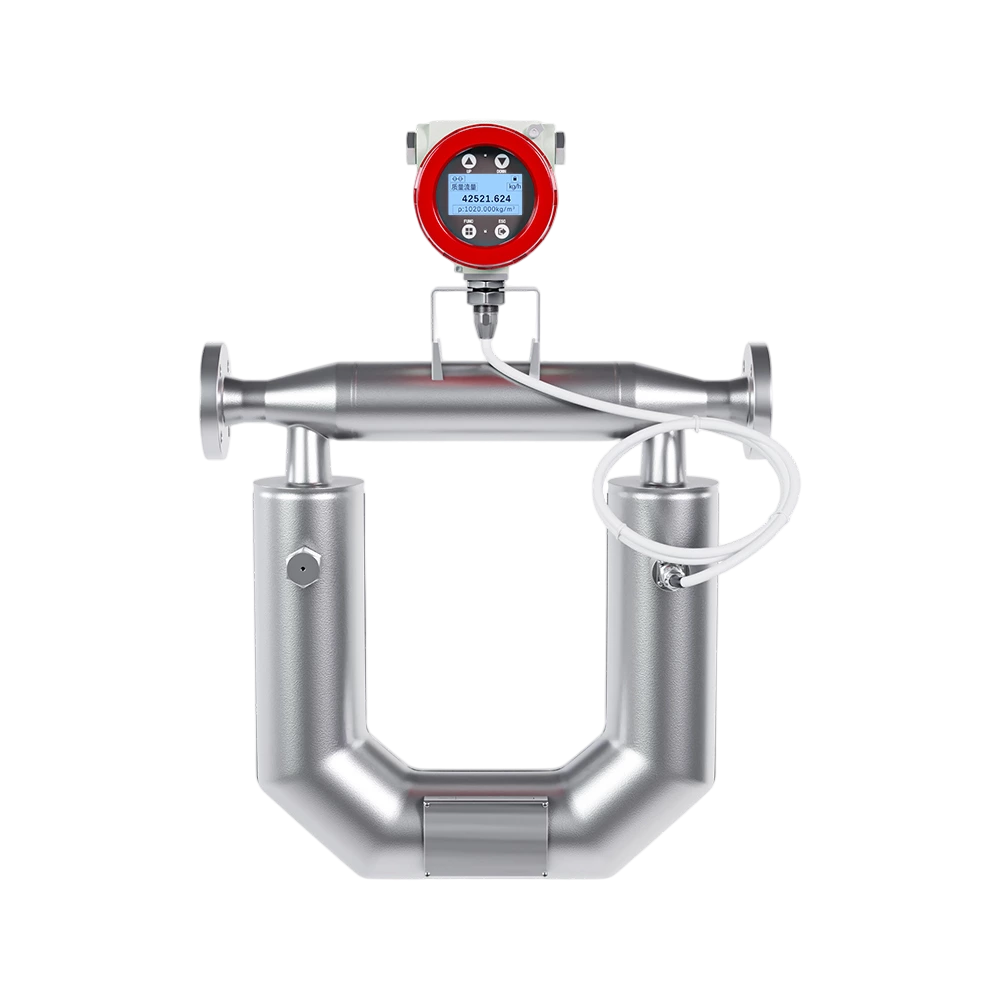
FCC-300 Coriolis Effect Mass Flow Meter For Oil, Gas, Liquid Processing
FCC-300 Coriolis Effect Mass Flow Meter For Oil, Gas, Liquid Processing
Regular price
$9,081.00 USD
Regular price
Sale price
$9,081.00 USD
Quantity

Introduction
The Coriolis mass flow meter is a new type of flow measurement instrument developed based on the Coriolis force principle. It can directly measure the mass flow rate, medium density, and temperature of fluids in closed pipelines. It can be widely used in industries such as chemical, petroleum, food, pharmaceutical, and papermaking.
Specification
Diameter :
- U-type:DN20~DN150; Triangular:DN3~DN15; Straight Tube:DN8~DN80
Measurand:
- Mass flow, density, temperature
Density accuracy:
- Earth 0.002g/cm³
Accuracy :
- 0.1%,0.15%,0.2%
Temperature:
- -40℃~+60℃
Power consumption:
- <15W
Power supply:
- 220VAC ; 24VDC
Signal output :
- 4~20mA, RS485, HART
Ingress protection:
- IP67
Density range :
- (0.3~3.000)g/cm³
Repeatability:
- 1/2 of the measurement error
Medium temperature:
- Standard type: (-50~200)℃, (-20~200)℃; High temperature type: (-50~350)°C; Low-temperature type: (-200~200)°C
Process pressure:
- (0~4.0)MPa
Humidity:
- 35%~95%
Transmission output:
- (4~20) mA, output load (250~600) Ω

Measuring principle
When a fluid flows through a rotating or vibrating tube, it generates a Coriolis force proportional to its mass flow rate. A fluid particle is subject to centripetal acceleration and Coriolis acceleration, from which the Coriolis force can be derived and expressed as a function of mass flow.
In practice, Coriolis mass flowmeters use a vibrating tube instead of a rotating one. With no flow, the tube vibrates in phase. As fluid passes through, Coriolis forces cause the two sections of the tube to twist in opposite directions, producing a phase difference directly proportional to the mass flow rate. By measuring this phase difference, the meter accurately determines mass flow, density, and other process variables.
